What I've picked up from tech news over the last few weeks/months
I've come across quite a few interesting news stories over the last few days, especially around AI, development and IT security. Some of them are quite revealing of how quickly our profession is changing...
Here is a small selection of what I found interesting on the internet recently.
AI and development
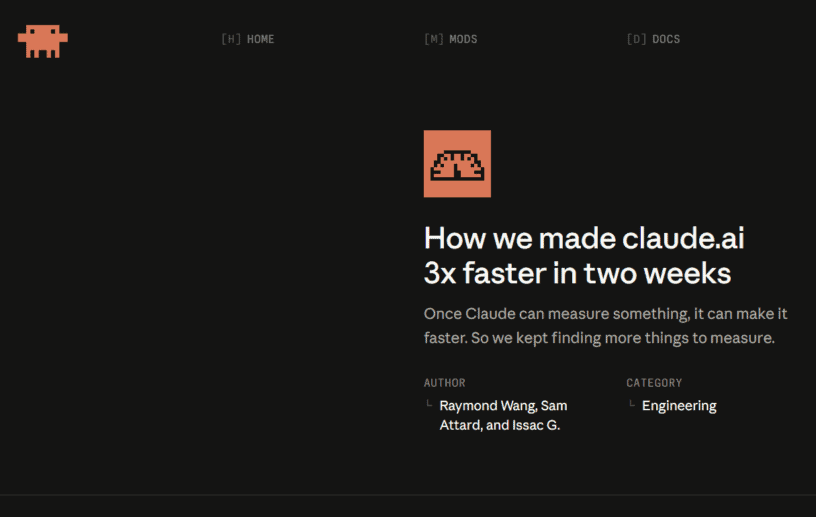
Claude made claude.ai three times faster in two weeks
This is probably one of the most interesting demonstrations I've seen recently of how AI agents can be used in development.
The Anthropic team explains how they used Claude to speed up claude.ai. The goal was ambitious: improve the interface performance by a factor of three in just two weeks.
The most interesting part is the method they used. Claude identified bottlenecks, wrote benchmarks to measure performance and directly suggested optimizations.
Obviously, the team didn't just let the AI modify the code without any checks. The results were measured, the improvements were verified, and optimizations were only kept when they actually brought a real improvement.
How we made claude.ai 3x faster in two weeks
Anthropic is developing its own version control system to replace Git internally
Here's some news that could get quite a few developers talking: Anthropic has developed its own version control system, called Scion, to replace Git in its monorepo.
The reason behind it is quite interesting. With the growing number of AI agents, the volume of changes and merges to manage is becoming particularly large. Working habits are changing, and traditional tools are not necessarily designed to handle this new pace. Anthropic says it has reached volumes of several tens of thousands of merges per day.
Scion was therefore designed to meet these specific needs, particularly when it comes to agents working in parallel and managing changes.
Keep in mind, though, that this isn't a new Git intended to replace the one we all use. The project isn't open source 🙁 and Anthropic says it mainly addresses its own internal constraints.
Well, for now, it's difficult to have an opinion. My Git works perfectly well for me (although I use fewer agents than Anthropic...).
Scion: why Anthropic is replacing Git
Linus Torvalds admits he uses AI for certain tasks
The creator of Linux explains that he uses AI to do some things he doesn't particularly know how to do. He sees vibe coding in particular as a fun way to discover programming and enjoy developing. However, he doesn't consider this approach suitable for developing Linux.
The distinction is interesting. Using AI to experiment, investigate a bug or perform a small task doesn't necessarily mean handing over responsibility for a complex project.
I think this is quite a healthy approach. There's no need to systematically reject AI, but there's no need to want to use it everywhere either.
"I use AI to do things I don't know how to do well", says Linus Torvalds
IT security
Instructions for AI agents discovered in HTTP headers
Here's a rather unusual topic. An analysis of 217 million HTTP responses identified several thousand websites sending headers intended for AI agents. A total of 7,959 websites were reportedly identified, some of which contained prompt injection attempts.
We already knew about the risks of prompt injection in web pages, documents or content retrieved by agents. But seeing this type of content directly in HTTP headers opens up another attack vector.
An AI agent retrieving information from a server may also end up interpreting instructions contained in the response metadata.
The problem is that these instructions can be treated as ordinary content, even though they are trying to influence the agent's behaviour.
This is a reminder of an important rule: data retrieved from the Internet must remain untrusted data, even when it is presented in technical elements that seem harmless.
Prompt injection in HTTP headers
Anthropic launches a free security scanner for open source projects
Anthropic is also offering OSS Scanner, a service designed to analyse the security of open source projects using its AI models. The goal is to detect vulnerabilities and potential problems in code to help maintainers improve their projects.
The raw results are sent to maintainers who request them. This is an interesting initiative, especially for small open source projects that don't necessarily have the resources to carry out regular security audits.
Anthropic launches OSS Scanner to audit open source code
Development and tools
Deno joins Cloudflare
This is important news for the JavaScript ecosystem: the team behind Deno is joining Cloudflare! The Deno runtime remains open source and will continue to be maintained. However, Deno Deploy, its hosting service, is expected to close within six months, with support planned for migrating to Cloudflare Workers.
For those who don't know Deno, it's a JavaScript and TypeScript runtime created by Ryan Dahl, who also created Node.js. It offers another approach to running JavaScript on the server side, with particular attention to security and permissions.
This move to Cloudflare makes quite a lot of sense given the company's activities around running code at the edge of the network. We'll see how this integration develops.
PEAR, the first PHP package manager, could disappear
A little trip back through PHP history with PEAR, whose development started in 1999. Personally, I've been using it since 2007. Ah, memories... Before Composer, PEAR was one of the solutions for distributing and installing PHP libraries.
It had its moment of glory, but gradually lost ground to Composer, which has become essential in the PHP ecosystem. An RFC is now proposing to withdraw official PHP support for PEAR and remove some related components starting with PHP 8.7.
It's quite amusing to see how quickly tools that we consider essential today can become obsolete!
The History of PEAR, PHP's First Package Manager
Infrastructure and networking
Quad9 is leaving France
Some news concerning France (since I'm French, I'm including it in this article). If you use the public DNS resolver Quad9 with the address `9.9.9.9`, this news is worth your attention.
The French courts have ordered Quad9 to block several websites illegally broadcasting sports events, following a request from beIN Sports, a television broadcaster. Quad9 refuses to implement this filtering, arguing that it cannot be done reliably without compromising the neutrality of the service or extending the blocking to other countries. The foundation therefore prefers to withdraw its service from France starting November 24, 2026.
For users in France, it will be necessary to change their DNS configuration if they currently use Quad9, especially if the address is configured directly on a router or server.
Quad9 is leaving France: DNS 9.9.9.9 will be shut down on November 24, 2026
A few other news stories
The end of the leap second is approaching
The International Bureau of Weights and Measures has voted to abolish the leap second, whose role was to keep UTC time in line with the Earth's rotation.
Some servers, software and time synchronization systems, including task managers, don't always handle its insertion very well. This can cause unexpected behaviour or even service interruptions. I have a colleague who has already had this problem with one of his services...
The change is planned for May 20, 2027, which is coming up quickly. A small change that should make life easier for some developers and system administrators!
The end of the leap second has been approved to avoid computer bugs
Margaret Hamilton, a pioneer of software engineering, has died
Margaret Hamilton has died at the age of 90. She led the team responsible for developing the onboard software for the Apollo program, including NASA's lunar missions.
She also helped establish software engineering as a recognised discipline in its own right.
Her work contributed to the reliability of the computer systems used during the Apollo missions, at a time when hardware resources were particularly limited.
She is an important figure in the history of computing, and a reminder that software development obviously didn't begin with the arrival of personal computers!
Margaret Hamilton, computing pioneer who led software development for the Apollo program, dies at 90
To finish
Well, there is quite a lot of AI in this news roundup... and it's not going to stop anytime soon!

cyrilou
-

Getting a New Website Indexed by Google: Technical Tips to Know
Ten years ago, the usual advice was to put your website online, share a few links on forums, and wait for Google to discover it. That approach has been outdated for a long time. Today, Google still needs to discover your pages, but it must also crawl them and decide whether to index them. A […]
-
GitHub Copilot: When AI makes developers' bills skyrocket
Using GitHub Copilot used to be fairly straightforward when it came to billing: you paid a monthly subscription and had access to a certain number of requests, with a few limitations depending on the model used. But since June 2026, GitHub has changed the rules of the game. Premium requests have been replaced by a […]
-

Rework in software development: Why reworking is part of the job
We often talk about productivity, deadlines, and delivered features. It's easy to measure what has been created, much less so the work required to revisit what already exists. Yet rework is an integral part of our daily lives as developers. Revisiting a feature, rethinking an architecture, fixing an implementation, or even starting from scratch on […]
-

What I've picked up from tech news over the last few weeks/months
I've come across quite a few interesting news stories over the last few days, especially around AI, development and IT security. Some of them are quite revealing of how quickly our profession is changing... Here is a small selection of what I found interesting on the internet recently. AI and development Claude made claude.ai three […]
-

The impact of technology on business scalability
Businesses must be both fast and adaptable—two essential levers for growth. Technologies like AI, automation, and cloud computing have become indispensable. Failing to adapt means risking serious setbacks compared to the competition. I once worked for a software company that didn’t believe in the cloud—this cost them dearly… We’ll explore how these tools are transforming […]
-

Artificial Intelligence: The next technological revolution after the Internet?
The creation of the Internet at the end of the last century revolutionized our lives (for better or worse, depending on one's perspective…). But it didn't happen overnight; it took decades to profoundly transform our societies after its invention. Artificial intelligence seems to be following a similar trajectory. Often overestimated in the short term—just look […]