GitHub Copilot: When AI makes developers' bills skyrocket
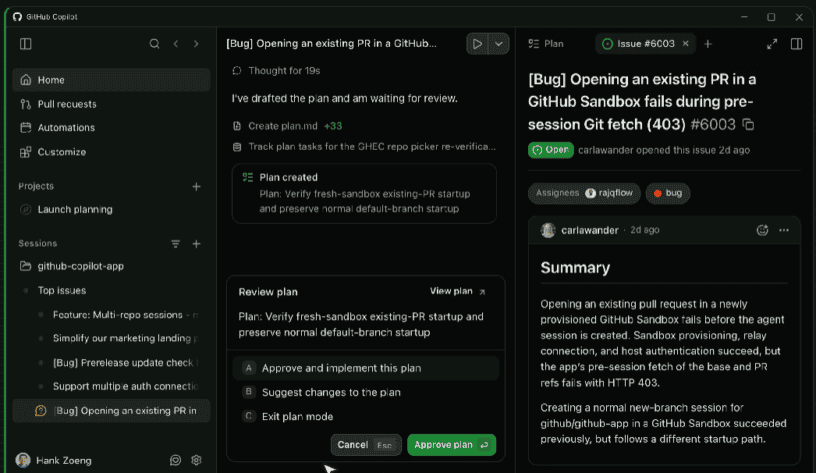
Using GitHub Copilot used to be fairly straightforward when it came to billing: you paid a monthly subscription and had access to a certain number of requests, with a few limitations depending on the model used.
But since June 2026, GitHub has changed the rules of the game. Premium requests have been replaced by a billing system based on actual token consumption.
This changes quite a few things, especially for those who use AI assistants intensively for development.
Personally, I often find myself paying $60 per month, and I know others who manage to reach several thousand dollars per month. That's huge! Enough to raise a few questions before letting an AI agent work on a project for several hours.
How does GitHub Copilot's new billing system work?
The idea is that each interaction with an AI model consumes credits, whose cost depends on the number of tokens used and the model selected. This includes input tokens (the context sent to the model), output tokens (the code and explanations generated) and cached tokens.
A simple question asked in Copilot Chat will therefore not cost the same as a long session during which an agent analyzes several files, modifies code, runs tests and tries again several times.
This is precisely one of the major changes: previously, an interaction could consume just one premium request, even if the work performed behind the scenes was very different. With the new system, the cost better reflects the work actually performed.
How much does GitHub Copilot cost now?
Subscriptions haven't disappeared, but they now provide access to a monthly AI credit allowance. Here are the main individual plans (November 2026):
| Plan | Monthly subscription | Included monthly credits |
|---|---|---|
| Copilot Pro | $10 | $15 |
| Copilot Pro+ | $39 | $70 |
| Copilot Max | $100 | $200 |
These credits are not equivalent to a fixed number of requests. Their consumption depends on the model used and the volume of tokens processed. Once the allowance has been used up, it's possible to keep working by enabling additional paid usage. It's also possible to set a budget to limit spending.
Note that standard code completions and Next Edit suggestions remain included in paid subscriptions and do not consume these credits.
Why can the bill quickly add up?
The problem mainly concerns AI agents. When you ask Copilot to modify a function, consumption generally remains reasonable. However, when you give it a complex task, it can perform many operations in succession:
- Analyze several project files.
- Read large portions of code.
- Search for dependencies.
- Modify several files.
- Run tests.
- Analyze errors.
- Try the modifications again.
Each step can trigger new interactions with the model and therefore additional consumption. Context also plays an important role. A very long conversation may require a large number of tokens to be sent again with each interaction.
The choice of model is another determining factor. Models that perform better at reasoning and complex tasks are generally more expensive than lightweight models.
This explains why two developers using Copilot for a similar amount of time can have very different levels of consumption.
Claude Code: a more predictable alternative?
The Pro plan costs $20 per month with monthly billing and includes Claude Code. For heavier users, Max plans start at $100 per month and offer five times more usage than Pro. An Ultra plan at $200 offers ten times more weekly usage than Pro.
This makes it easier to anticipate your budget, even though usage limits still exist. Otherwise, it would have been too good to be true. Anthropic also offers additional usage credits to keep working after reaching your subscription limits. It's also possible to use the API, with separate billing based on actual consumption.
Claude is therefore not completely immune to the same problem. The difference is that the standard subscription allows you to keep a fixed budget, provided you're willing to accept usage limits and wait for them to reset.
So, should you abandon GitHub Copilot?
Not necessarily, but it's worth asking yourself the question if you're a heavy user. GitHub Copilot remains interesting because of its integration with the GitHub ecosystem, its various IDE integrations and the ability to use several models and agents.
But the billing change means you have to keep a closer eye on your consumption. Claude Code can be an interesting alternative for those who prefer a subscription with relatively predictable usage limits. That said, all of this is likely to change over the coming months, so it's worth keeping an eye on.
In short, it's worth checking things out and trying a few options to see how much your own usage actually costs.
Sources

cyrilou
-

Getting a New Website Indexed by Google: Technical Tips to Know
Ten years ago, the usual advice was to put your website online, share a few links on forums, and wait for Google to discover it. That approach has been outdated for a long time. Today, Google still needs to discover your pages, but it must also crawl them and decide whether to index them. A […]
-
GitHub Copilot: When AI makes developers' bills skyrocket
Using GitHub Copilot used to be fairly straightforward when it came to billing: you paid a monthly subscription and had access to a certain number of requests, with a few limitations depending on the model used. But since June 2026, GitHub has changed the rules of the game. Premium requests have been replaced by a […]
-

Rework in software development: Why reworking is part of the job
We often talk about productivity, deadlines, and delivered features. It's easy to measure what has been created, much less so the work required to revisit what already exists. Yet rework is an integral part of our daily lives as developers. Revisiting a feature, rethinking an architecture, fixing an implementation, or even starting from scratch on […]
-

What I've picked up from tech news over the last few weeks/months
I've come across quite a few interesting news stories over the last few days, especially around AI, development and IT security. Some of them are quite revealing of how quickly our profession is changing... Here is a small selection of what I found interesting on the internet recently. AI and development Claude made claude.ai three […]
-

The impact of technology on business scalability
Businesses must be both fast and adaptable—two essential levers for growth. Technologies like AI, automation, and cloud computing have become indispensable. Failing to adapt means risking serious setbacks compared to the competition. I once worked for a software company that didn’t believe in the cloud—this cost them dearly… We’ll explore how these tools are transforming […]
-

Artificial Intelligence: The next technological revolution after the Internet?
The creation of the Internet at the end of the last century revolutionized our lives (for better or worse, depending on one's perspective…). But it didn't happen overnight; it took decades to profoundly transform our societies after its invention. Artificial intelligence seems to be following a similar trajectory. Often overestimated in the short term—just look […]